The format of the SAT
Before starting your SAT prep, it is important to understand the digital adaptive nature of the test. Instead of every student seeing the same questions, the SAT exam adjusts to your skill level as you go.
How the adaptive modules work
Your performance in the first module of each section sets the tone. Here you'll face a mixture of easy, medium, and hard questions. By doing well on the first module, you'll move on to a harder second module. Those questions are more challenging, but they're also where the highest scores come from. If you're aiming for a 700–800 section score, you want to make sure you get the harder second module. This is why taking full-length practice tests before test day matters so much.
Built-in support and accessibility
One of the major reasons the College Board transitioned the SAT to a digital test in 2024 was to level the playing field for students. Students can use features like extended time, text-to-speech, and the built-in Desmos calculator to focus on the questions instead of the logistics. The goal is simple: remove distractions and barriers so your score reflects what you actually know. If you need extended time, a borrowed device, or other supports, see our SAT accommodations guide.
Reading and writing on the SAT
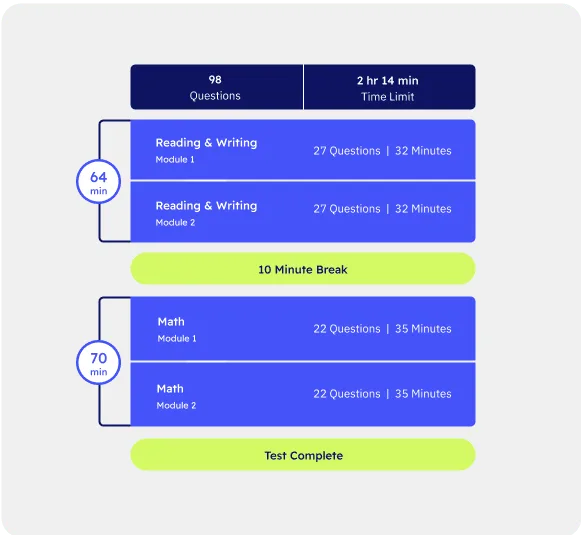
65 min
Total time
54 questions
Total questions
On the Reading and Writing (R&W) section of the SAT, each question is paired with its own unique text, ranging from 25 to 150 words.
This section is multistage adaptive. How well you do in the first module determines the difficulty of the second, so early accuracy matters more than ever. Students who perform well in the opening module unlock harder questions and higher score potential.
In total, the Reading and Writing section lasts 64 minutes and includes 54 questions, split evenly across two modules. Questions are grouped by skill rather than by subject, which means you may jump quickly between grammar, vocabulary, science, history, and literature. Success comes from reading efficiently, recognizing patterns, and applying rules consistently under time pressure.
⚡Big picture
The four content domains
The College Board organizes Reading and Writing questions into four domains that test how well students understand, analyze, and revise text:
| Domain | Weight | Key subdomains |
|---|---|---|
| Craft and structure | ~28% | Words in context (vocabulary), analyzing text structure and purpose, and cross-text connections (comparing two passages). |
| Information and ideas | ~26% | Central ideas and details, command of evidence (textual and quantitative/graph-based), and inferences. |
| Standard English conventions | ~26% | Sentence structure, usage, and punctuation (boundaries, form, and agreement). |
| Expression of ideas | ~20% | Transitions (logical connection words) and rhetorical synthesis (organizing provided notes to achieve a specific goal). |
What this means for students:You don't need to be a fast reader. You need to be precise, especially in the first module.
Dive deeper: SAT Reading & Writing strategies
Math on the SAT
70 min
Total time
44 questions
Total questions
The SAT Math section is fully adaptive, and students may use a graphing calculator for every question. Desmos is built directly into Bluebook, the testing app, making smart use of tools a real advantage on test day.
The section lasts 70 minutes and includes 44 questions, split into two adaptive modules. As with Reading and Writing, your performance in the first module determines the difficulty of the second. Strong early performance is the only way to reach the highest score ranges.
⚡Big picture
The four content domains
All Math questions fall into four content areas that reflect college readiness. While the topics may look familiar, the digital format rewards students who know when to use Desmos to graph, solve, or check work instead of doing everything by hand.
| Domain | Weight | Key subdomains |
|---|---|---|
| Algebra | ~35% | Linear equations (one and two variables), linear functions, systems of linear equations, and linear inequalities. |
| Advanced math | ~35% | Equivalent expressions, nonlinear equations (quadratic, exponential, polynomial, rational, radical), and nonlinear functions. |
| Problem-solving and data analysis | ~15% | Ratios, rates, proportions, percentages, probability, and analyzing one-variable and two-variable data (scatterplots, mean, median). |
| Geometry and trigonometry | ~15% | Area and volume, lines, angles, triangles, right triangles, circles, and trigonometric ratios (sin, cos, tan). |
What this means for students: Mastering Desmos and pacing early questions well can be the difference between a good score and a great one.
Dive deeper: strategies, tips, and tricks for the Math section
The Desmos advantage and using the built-in calculator
Throughout the entire Math section on the SAT, students have access to Desmos, the built-in graphing calculator. You can bring a handheld calculator, like a TI-84, if you'd like, but students who learn with Desmos gain a real speed advantage. Many questions that would take a minute or two by hand can be solved in seconds with the right setup.
Here's where Desmos really shines:
- Instant visual answers: Type in equations to solve systems or find roots of a quadratic, and Desmos immediately shows intersections, vertices, and intercepts.
- Dynamic sliders: Adjust constants like a or kin real time to see how graphs change. This is especially useful for questions about “no solution” or “infinite solutions.”
- Regressions & tables: Drop values into a table and let Desmos generate the equation of a line or curve for you. This is a huge time saver on data and modeling questions.
- No equation rewriting required: Unlike many handhelds, Desmos graphs equations exactly as they appear, even if they are not written in slope-intercept form.
⭐What this means for students
Dive deeper: Desmos cheat sheet
Scoring and goal setting on the SAT
The first step in SAT prep is knowing what you're aiming for. Most students set their goal based on the “middle 50%” score range of admitted students at their target schools. As a rough guide, that often means 1500+ for highly selective colleges and 1200–1400 for many competitive state schools.
Once you take a full-length practice test, you'll have a baseline score. From there, you can see how far you are from your goal and build a realistic plan to close the gap. For many students, meaningful improvement usually comes from about 40 to 80 hours of focused study, depending on where they're starting.
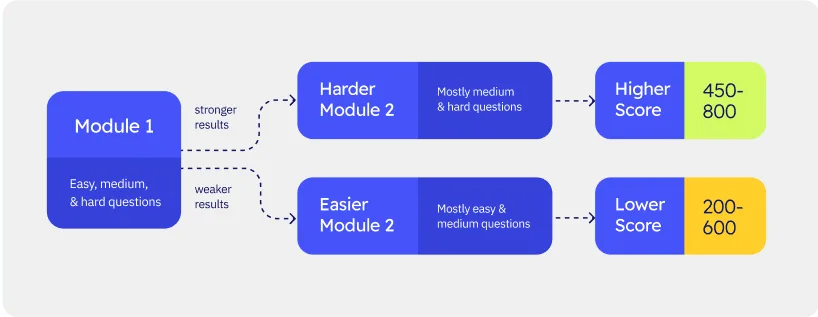
The SAT is scored on a 400–1600 scale and uses a multistage adaptive format. How you perform in the first module of each section determines the difficulty of the second. Because harder questions are worth more, strong early accuracy can have an outsized impact on your final score. There is still no penalty for guessing, so every question is worth attempting.
💡What this means for students
Dive deeper: SAT scoring and goal setting. If you're also considering the ACT, see our ACT to SAT conversion chart to compare scores.
Pacing and time management on the SAT
Time management is essential on the digital SAT. Because the exam is multistage adaptive, how you perform in the first module directly affects your score ceiling in the second. There is no warm-up period, so every early question counts.
To stay on pace, focus on a few digital-first habits that consistently save time:
- Read the question first:Reading & Writing passages are now short. Knowing what you're looking for before reading the text helps you move faster and stay focused.
- Use the flag-and-move-on rule: If a question is taking longer than 90 seconds, flag it and keep going. Lock in the easier points first, then come back if you have time.
- Let the tools do the work: Use answer elimination to narrow choices quickly, and rely on Desmos to handle graphing or calculations that would take much longer by hand.
Used well, these habits help you stay calm, protect accuracy, and avoid running out of time when the questions get harder. The best way to practice time management is by taking consistent full-length tests and analyzing your pacing results with a platform like Acely.
✏️Key insight
Dive deeper: why time management is essential on the SAT
Building your custom study plan
Strong SAT prep usually happens in two phases: getting a realistic baseline, then improving through focused repetition. To start, you can take a full-length, adaptive practice test on either Acely or the Bluebook™ app. Both platforms provide the exact interface and built-in tools you will use on test day. Many students find that taking a combination of both is the best way to get a well-rounded picture of their potential performance across different levels of difficulty.
Need a ready-made schedule? Use our 1-month SAT study plan for a focused sprint, or our 3-month SAT study plan for a steadier buildup to test day.
SAT test dates
Planning when to take the SAT helps you align with registration deadlines and your college application timeline. Below are confirmed U.S. test dates for 2026–27. For registration deadlines, late registration, and changes or cancellations, check the College Board website. Students who need to borrow a device or request accommodations should register earlier than the standard deadline.
- May 2, 2026
- June 6, 2026
- August 22, 2026
- September 12, 2026
- October 3, 2026
- November 7, 2026
- December 5, 2026
- March 6, 2027
- May 1, 2027
- June 5, 2027
Register at collegeboard.org. Late registration is available; additional fees may apply.
Getting ready for test day
Doing well on test day isn't just about what you know. It's also about showing up prepared, so nothing distracts you once the test starts. A little planning the night before can go a long way.
Your test day packing list
Pack your bag ahead of time so the morning feels calm and predictable.
- The essentials:
• A fully charged device: Bring a laptop or tablet with the Bluebook™ app installed and the Exam Setup completed. Try to do this a few days in advance to avoid last-minute surprises.
• Your admission ticket: You can access this inside Bluebook after completing setup. A printed copy is ideal, but a digital version is also accepted.
• A physical photo ID: This must be an original, valid school-issued or government-issued ID. Digital IDs are not accepted. - Power & tech:
• Power cord & portable charger: Outlets are not guaranteed, and your device needs to last about three hours.
• External mouse/keyboard (optional): Note that external keyboards are only allowed for tablets, not laptops. - Comfort & support:
• Writing utensils: Bring a pen or pencil for scratch work. Paper is provided at the test center.
• Handheld calculator: This is optional, as Desmos is built into the app.
• Snacks & water: These must stay under your desk or in a designated area and can only be used during the break.
Timeline: what to expect
7:45 am
Check-in
Check in at the test center, where a proctor will verify your ID and admission ticket.
8:00 am
Setup
After you’re seated, you’ll connect to the center’s Wi-Fi, open Bluebook, and enter a start code provided by the proctor.
8:15 am
Testing begins
The exam is individually timed, so your break may not line up exactly with other students in the room.
Break
10-minute break
You’ll have one 10-minute break between the Reading & Writing and Math sections. During the break, you must leave the testing room and cannot use your phone or other prohibited items. If you have accommodations, breaks may look different for you.
Completion
Submit
After the final Math module, Bluebook will submit your answers automatically. Keep your device open until you see the confirmation screen letting you know the test is complete.
Retakes, superscores, and sending scores
For most students, the SAT isn't a one-and-done experience. In fact, about two out of three students improve their score on a second attempt, which is why the College Board recommends taking the SAT at least twice.
Many colleges also use superscoring, meaning they'll combine your highest Math score and your highest Reading & Writing score from different test dates to create a new, higher composite score. That makes retakes less risky and often well worth it.
Here's a simple ~6-month plan to follow as you map out taking the SAT:
Your 6-month SAT game plan
- 1Spend the first few months building a strong foundation and taking your initial test, often in the spring of your sophomore or junior year. Many students opt to start in their sophomore year to space out their schedule with AP exams in junior year.
- 2Use your results to identify specific weak spots, focus your practice, and retake the exam later in the summer or early fall to maximize your superscore.
- 3Depending on your second attempt and college application deadlines, you can always test a third time to hit your goal superscore. This is why starting in the sophomore year can be beneficial.
This plan gives you breathing room to balance SAT prep with AP exams, extracurriculars, and college applications, without trying to do everything at once.
Don't forget: Your first score is just a starting point. Retakes can be your best friend and can help you achieve your goal superscore.
Dive deeper: building the ultimate SAT retake game plan