Expert-created questions to ace AP Precalculus
Master multiple-choice questions with Acely's extensive question bank and AI tutor.
An AI tutor to change AP Precalculus prep
Ditch the static textbooks for instant AI-powered feedback on everything from polynomial behavior to complex polar transformations.
- Master multi-step solutions:Don't just get the answer. Understand the why behind complex manipulations in Unit 1 (Polynomial & Rational Functions).
- Bridge the Calculus gap: Focus your study time on the concepts that actually transition to AP Calculus AB/BC, like Limits and Continuity.
- Formula fluency: Instant hints for Unit 3 (Trigonometric Identities) so you never get stuck on a Pythagorean identity again.
- Predictive performance: Our dashboard tracks your progress across all 4 Units to predict your score before the May exam.
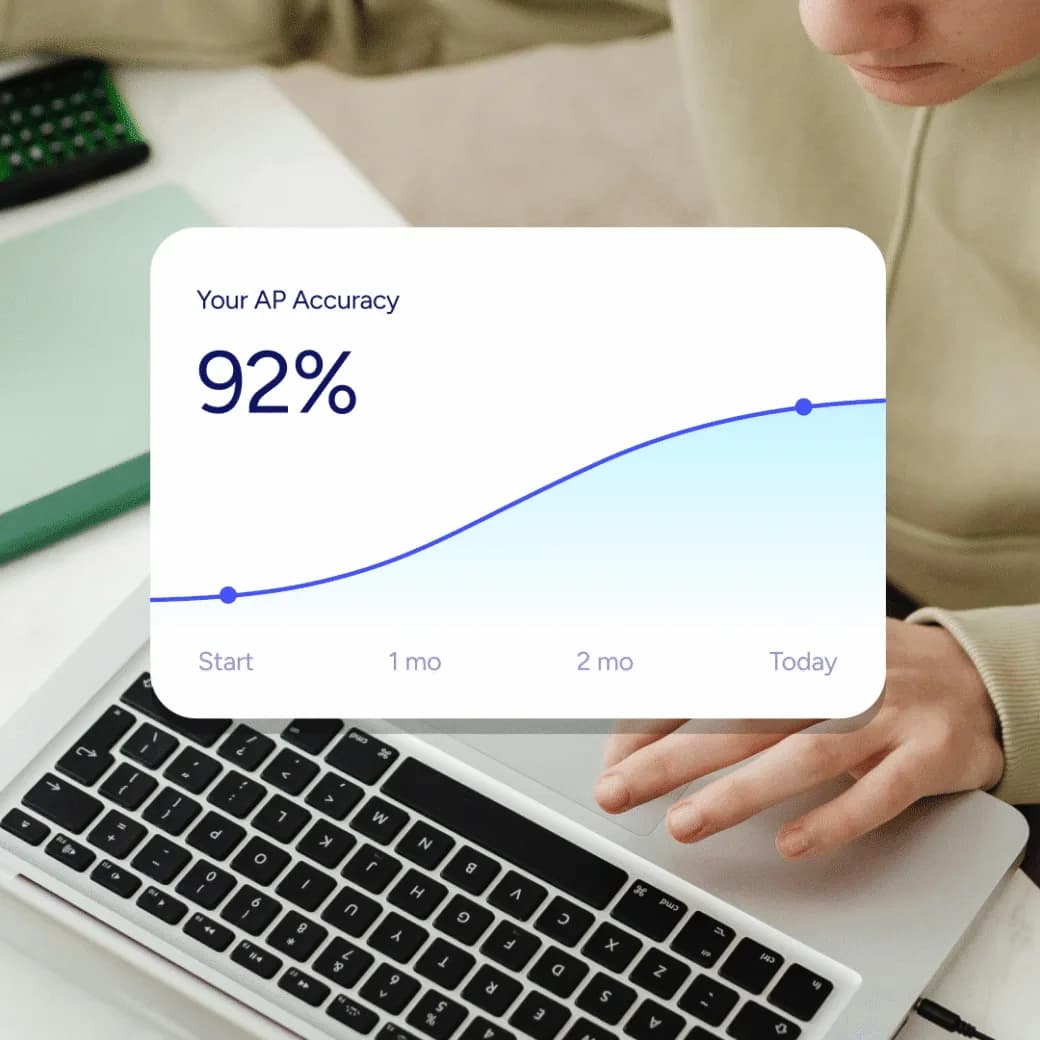
Track your progress before test day
62.5% of your score on the AP Precalculus exam is based on the multiple-choice question. By practicing and tracking your progress, you can go into test day with confidence on the MCQ question and ready to apply your knowledge on the Free Response Questions (FRQ).
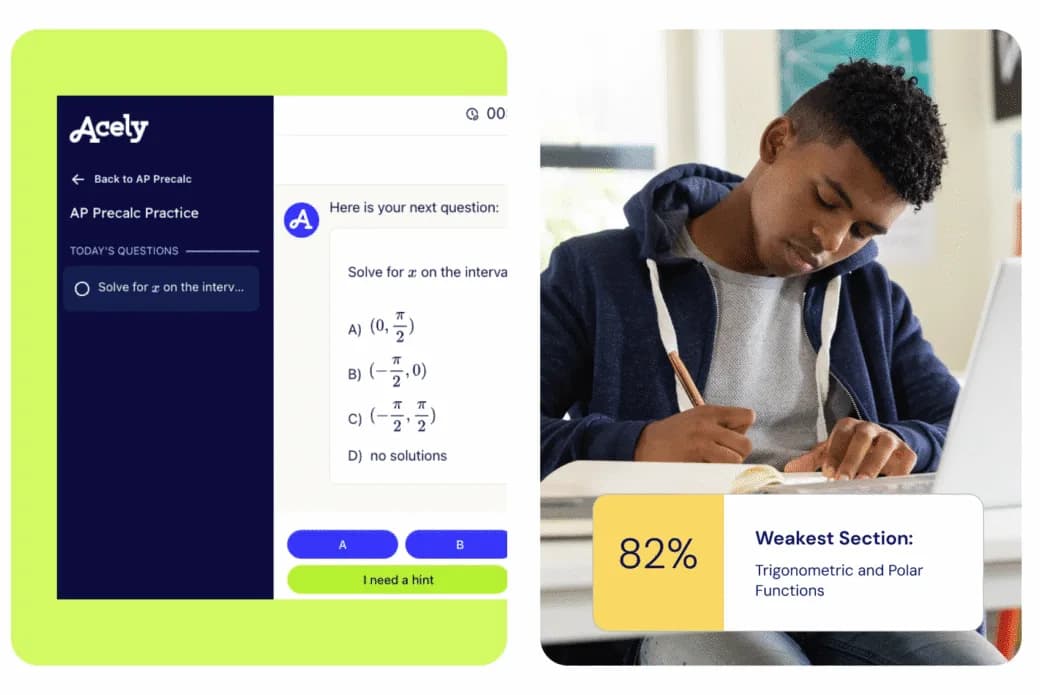
All about AP Precalculus
Aligned with the rigorous course content defined by the College Board, this examination delves into the foundational functions and modeling techniques that govern the physical world. From the intricate behaviors of polynomial and rational functions to the marvels of trigonometric transformations, students explore the big ideas shaping the bridge to higher-level calculus. Through a blend of multiple-choice and free-response questions, students demonstrate their mastery of procedural fluency and data-driven modeling. They unravel the complexities of periodic phenomena and their impact on the diversity of STEM applications.
Master multiple-choice questions for every AP Precalculus unit
AP Precalculus covers four foundational units, from polynomial functions to symbolic manipulations with vectors. Our platform offers specific practice questions for each topic to build confidence for test day.
Unit 1.1: Polynomial Functions
Master end behavior, zeros, and multiplicities of polynomial functions to model real-world data patterns.
Unit 1.2: Rational Functions
Navigate vertical asymptotes, holes, and limits as you analyze the rate of change in rational expressions.
Unit 2.1: Exponential Growth
Explore arithmetic and geometric sequences as the foundation for modeling exponential growth and decay.
Unit 2.2: Logarithmic Functions
Master the properties of logarithms and semi-log plots to linearize and solve complex exponential equations.
Unit 3.1: Trigonometric Functions
Study periodic phenomena using sine and cosine transformations, radian measures, and the unit circle.
Unit 3.2: Polar Coordinates
Navigate the polar coordinate system and master the conversion between rectangular and polar functions.
Unit 4.1: Parametric Functions
Analyze motion in the plane by defining x and y coordinates as functions of time or other parameters.
Unit 4.2: Vectors & Matrices
Solve complex STEM problems using vector operations and matrix transformations in two-dimensional space.
Acely pricing
Acely includes access to APs, SAT, ACT and PSAT.
No charge today • Cancel anytime • Score improvement guarantee
Start my 3-day free trialStart early. Boost confidence by May.

Deep dive into AP Precalculus essentials
While practicing our stimulus-based MCQs, supplement your review with our curated subject guides to master the critical concepts required for the 2026 digital exam (please note that the FRQs are still paper-based, but MCQs are digital).
- Function analysis & modeling: Master the behavior of polynomial and rational functions to understand how mathematical models represent real-world change.
- Trigonometry & periodic phenomena: Review this comprehensive guide on unit circle transformations and master the critical differences between sine and cosine modeling.
- Exam strategy: Read these essential tips for success and explore the best strategies for calculator-active vs. non-calculator sections on the digital exam.
FAQs
Get more insights on Acely AP Precalculus.
To earn a 5, students should practice with released FRQs and review official scoring guidelines. Ensure your calculator is in radian mode for all trigonometric problems. When answering free-response questions, always show your work, even on calculator-active sections, as readers look for clear mathematical reasoning to award full credit.
Unlike traditional math tests, AP Precalculus emphasizes modeling a non-periodic context and a periodic context using real-world data. You will be asked to interpret analytical representations of functions and explain how variables change together—a concept known as covariation. Success requires translating between graphs, tables, and verbal descriptions.
The AP Precalculus exam consists of two main sections. Section I includes 40 multiple-choice questions split into Part A (no calculator) and Part B (graphing calculator required). Section II features 4 free-response questions (FRQs) that assess your ability to model periodic contexts and perform symbolic manipulations. Students use the Bluebook app to view questions, but handwrite their FRQ answers in a paper booklet.
The exam primarily assesses understanding from Units 1 through 3. This includes polynomial and rational functions, exponential and logarithmic functions, and trigonometric and polar functions. You must be proficient in identifying vertical asymptotes, calculating the average rate of change, and transforming sinusoidal functions. While Unit 4 covers matrices and vectors, it is typically not featured on the standard AP Exam.