Expert-created questions to ace AP Calculus AB & BC
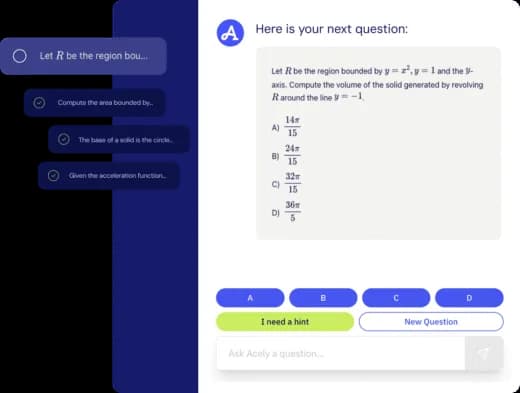
Acely's extensive question bank and AI tutor for the AP Calc multiple choice section gives students the targeted practice to get a 5 on test day.
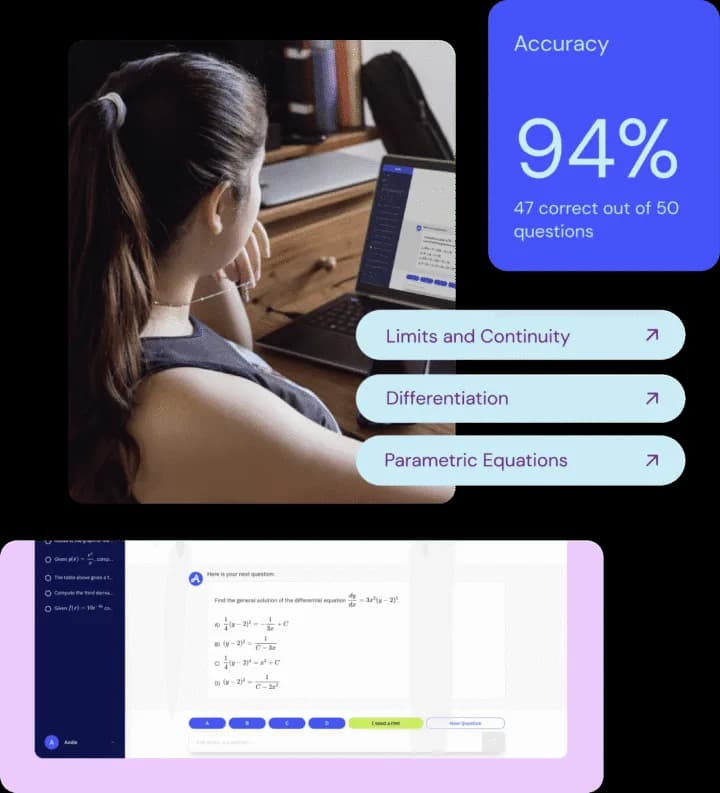
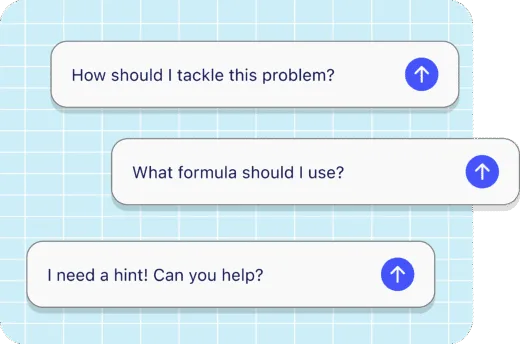
An AI tutor to change AP Calc prep
Ditch the static textbooks for instant AI-powered feedback on everything from foundational limits to complex Taylor Series expansions.
- Master multi-step integration: Understand the "why" behind U-substitution, Integration by Parts, and Partial Fractions.
- Bridge the BC gap: Target your study time on concepts like Parametric equations, Polar coordinates, and Infinite Sequences and Series.
- Graphical fluency: Get instant hints for analyzing function behavior, including Mean Value Theorem applications and First/Second Derivative tests.
- Predictive performance: Our dashboard tracks your progress across all 10 Units to predict your AB and BC subscores before the May exam.
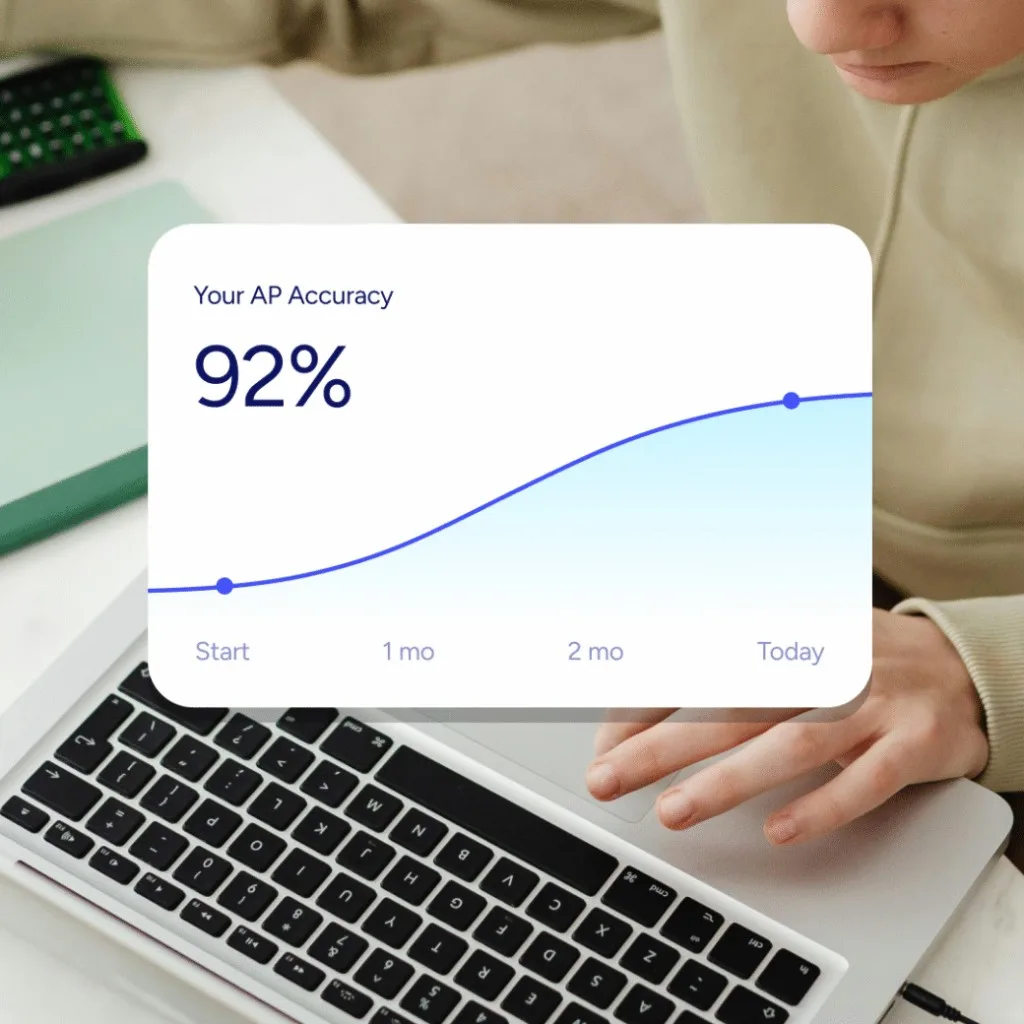
Track your progress before test day
50% of your score on either the AP Calculus AB & BC exam is based on the multiple-choice question. By practicing and tracking your progress on exam questions, you can go into test day with confidence on the MCQ question and ready to apply your knowledge on the Free Response Questions (FRQ).
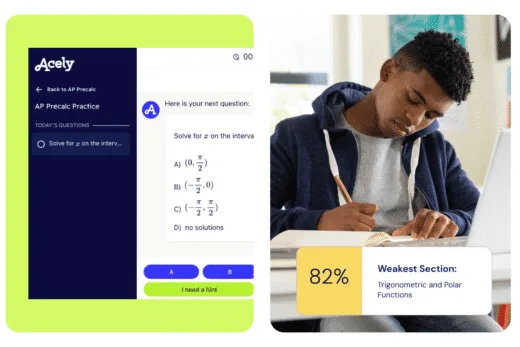
All about the AP Calculus AB exam
Aligned with the rigorous course content defined by the College Board, this examination delves into the foundational change and modeling techniques that govern the physical world. From the intricate behaviors of limits and continuity to the marvels of differential and integral calculus, students explore the big ideas shaping the bridge to advanced STEM careers. Through a blend of stimulus-based multiple-choice and complex free-response questions, students demonstrate their mastery of procedural fluency and data-driven modeling. They unravel the complexities of accumulation and their impact on a diversity of real-world applications.
All about the AP Calculus BC exam
Aligned with the rigorous course content defined by the College Board, this examination extends beyond foundational change to include the sophisticated modeling of vectors, polar coordinates, and infinite series. From the intricate behaviors of parametric equations to the marvels of Taylor and Maclaurin series expansions, students explore the big ideas that form the definitive bridge to multivariable calculus and engineering. Through a blend of stimulus-based multiple-choice and complex free-response questions, students demonstrate their mastery of advanced convergence tests and polar area modeling. They unravel the complexities of power series and their impact on the diversity of modern scientific computations.
Acely pricing
Acely includes access to APs, SAT, ACT and PSAT.
No charge today • Cancel anytime • Score improvement guarantee
Start my 3-day free trialStart early. Boost confidence by May.

Deep dive Into AP Calculus AB & BC essentials
While practicing our stimulus-based MCQs, supplement your review with our curated subject guides to master the critical concepts required for the 2026 digital exam (please note that the FRQs are still paper-based, but MCQs are digital).
- Limits, continuity, & derivatives: Master the foundational definition of the derivative and learn to navigate complex chain rule applications and implicit differentiation.
- Integration & accumulation: Review this comprehensive guide on the Fundamental Theorem of Calculus and explore BC-specific techniques like Integration by Parts and Partial Fractions.
- Series & parametrics (BC Only): Dive into Taylor and Maclaurin series to understand function approximation, and master the calculus of polar and parametric equations.
- Calc exam strategy: Read these essential tips for success and explore the best strategies for calculator-active vs. non-calculator sections on the digital exam.
FAQs
Get more insights on the AP Calculus exam.
Riemann sums are used to approximate the area under a curve by summing the areas of rectangles. This concept is the basis for the definite integral, which represents the exact accumulation of change over an interval.
You must master the power, product, and quotient rules, as well as the chain rule for composite functions. These are foundational for determining order derivatives (like second and third derivatives), which are used to analyze concavity and find the tangent line at a specific point.
For the AP exam, you must be able to model situations using differential equations and verify their solutions. Slope fields provide a visual representation of these equations, showing the rate of change at various points on a coordinate plane. Our step-by-step solutions guide you through the separation of variables and finding antiderivatives to solve for particular solutions.
Students should be comfortable estimating limits from graphs and tables. Understanding limits at infinity is essential for identifying vertical asymptotes and horizontal asymptotes of a function. Use our diagnostic tests to identify if you need more practice with the Squeeze Theorem or analyzing the behavior of trigonometric functions as they approach a limit.
Optimization is a major application of derivatives frequently tested in both multiple-choice and free-response sections. By working through practice problems, you learn to translate word problems into calculus problems that require finding the maximum or minimum value of a function. Mastering these helps you apply derivative rules to real-world scenarios, such as finding the largest area or lowest cost.